
What is TDR in Hyderabad real estate?
TDR (Transferable Development Rights) in Hyderabad is a certificate issued by GHMC (municipal authority) that allows additional construction area on a property.
In simple terms:
- When the government takes private land for public projects like roads, flyovers, parks, lake protection, or riverfront development,
- Instead of paying cash compensation, the government gives the land owner a TDR certificate.
This certificate gives the owner the right to build extra floor area on another property or sell that right to a builder.
Key takeaways of New TDR in Hyderabad
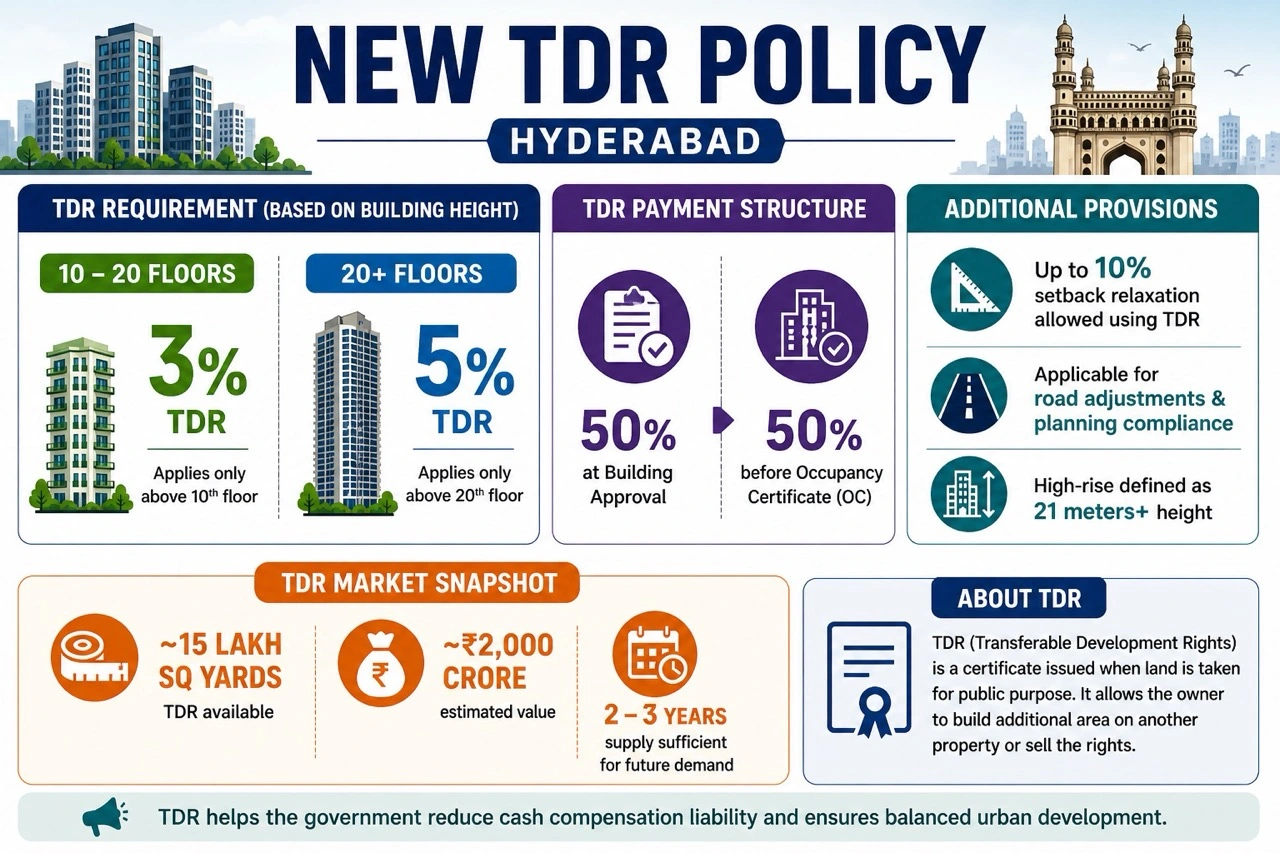
- The civic body still holds a large TDR stock. TOI reported that GHMC has over 15 lakh sq yards of TDR, worth about ₹2,000 crore, and builders said that stock can support built-up demand for the next two to three years.
- The new government order, G.O. Ms. No. 95, has changed the earlier blanket rule. High-rise buildings are now defined as structures 21 metres or more in height, excluding non-working components such as chimneys, cooling towers, lift machine rooms and water tanks. For plots between 750 sq m and 2,000 sq m, buildings between 18 metres and 21 metres can be built only through TDR, subject to parking and other norms.
- The biggest change is that the government has moved away from the earlier mandatory 10% TDR load for all floors above the 10th. Under the amended rules, buildings above 10 floors and up to 20 floors must use TDR for 3% of the built-up area above the 10th floor, while buildings above 20 floors must use TDR for 5% of the built-up area above the 20th floor. Developers can submit 50% of the TDR at the time of building permission and the remaining 50% before occupancy certificate.
- The rules also give more flexibility on setbacks and road-related changes. TDR can now be used for setback relaxations, with high-rises allowed up to 10% setback relaxation while still keeping a minimum seven-metre setback on all sides. Where master plan roads are altered or downsized, developers can now pay the development or conversion charges or provide equivalent TDR instead of only cash.
What the amended GO actually requires and why the state changed it
The original January rule required 10% TDR for high-rise buildings above 10 floors, and builders objected that it would push apartment prices up by about ₹350 to ₹400 per sq ft. The government then relaxed the rule through G.O. Ms. No. 95, apparently to balance real estate viability with its need to encourage TDR usage and reduce cash liability on public projects.
What this means in practice is that the old “one-size-fits-all” burden has been replaced by a slab system. Mid-range high-rises now face a lower TDR load than before, while very tall towers still carry a higher requirement. That should reduce the immediate cost shock for many projects, although the final impact will still depend on tower height, plot size, road width, and how quickly TDR is priced in the market.
For any building of 10 floors or more, the developer must use TDR to account for 10% of the built-up area above the 10th floor. The rule covers both new projects and existing projects that ask for revised plans or additional floors.
Why this rule exists:
- The state wants to avoid paying heavy cash compensation when it acquires private land for public works. The cash bill was estimated to run into thousands of crores if every owner chose money over TDR.
- The state and its agencies are taking land for roads, flyovers, riverfront, and lake works. They plan to issue TDRs instead of cash in most cases. This shifts compensation from cash to buildable rights.
- The civic body already holds a big stock of TDR. That stock is large enough to meet built-up demand for the next two to three years in the city, the administration says.
Key numbers from the data:
- About 15 lakh sq yards (~316 acres) of TDR exist with the civic body. The book value placed is ₹2,000 crore.
- Since 2017 the civic body issued 51.83 lakh sq yards of TDR to 1,585 owners after land acquisition. But only 34.49 lakh sq yards of that was used by buyers and developers. That left a surplus in the market.
- The government now makes partial mandatory use of TDR to push utilization and reduce cash liability.
Impact on Builders and Developers
Builders are the group most directly affected, but the amended rule is far easier to work with than the earlier version. The earlier 10% mandate created a sudden cost spike and a cash-flow issue because developers had to arrange TDR upfront. The revised rule lowers the loading to 3% and 5% slabs and allows half the TDR to be submitted later, before OC. That should ease project finance pressure, especially in the 10-to-20-floor bracket.
Short-term effects are now more moderate. Projects with approvals already in hand should face less disruption, while new approvals and revisions will need to follow the revised slabs. The cost increase that builders feared under the old rule should be lower now, because the mandatory share is no longer a flat 10% for every tall building.
Medium-term effects are likely to vary by product type. Taller towers will still see a higher TDR burden than mid-rise projects, but the new slab structure makes the economics more workable. On large plots, the revised road-width-based permissions also create more room for design planning.
What builders must do now
Check approvals carefully. Projects with sanctions already in place are less exposed than fresh applications or major revisions. Model TDR under the 3% and 5% slabs instead of the earlier 10% assumption. Also plan for the 50% upfront and 50% pre-OC submission schedule.
Impact on Buyers
Buyers will still see some price effect in new high-rise launches, but the pressure should be milder than under the earlier rule. Since the government has reduced the TDR burden and allowed phased submission, the pricing shock is likely to be smaller than the earlier estimates that were tied to the 10% mandate. That said, some portion of the TDR cost can still get built into the final sale price, especially in taller towers.
Who will feel it most? Buyers of new launches in taller buildings and buyers in corridors where developers keep adding height. Buyers of projects already approved before the revised norms should feel less of an immediate effect.
Why price changes happen is simple: developers still need to source TDR where the rule applies, and that cost gets factored into the project math. But because the new rule uses lower slabs than the old one, the burden is more manageable now.
Smart buyer moves
Prefer projects with existing approvals if price sensitivity matters. Ask the builder which TDR slab applies to the project. Re-run affordability with a small price buffer, but do not assume the old 10% TDR impact anymore.
Impact on Landlords and Investors
For landlords and investors, the amendment is more about market balance than a pure cost shock. The government has kept TDR central to urban growth, but it has made the rules more flexible. That should help high-rise supply remain viable while still preserving the TDR market.
The current TDR stock with GHMC is still large enough to matter. TOI reported more than 15 lakh sq yards of TDR in hand, and that supply was described as sufficient for about two to three years of demand in Greater Hyderabad.
For landowners whose land is taken for public purpose, TDR remains the key compensation route. The government still prefers TDR over cash in most cases because cash outgo can become very large.
Investor checklist
- If you are buying for rent, track whether the project is a 10-20 floor building or a 20+ floor tower, because the TDR burden now differs by slab.
- If you own land that may be acquired, expect TDR compensation to remain the main path.
- If you trade in under-construction inventory, projects with earlier approvals may still look attractive against new launches, but the gap should be narrower than before.
Practical steps each stakeholder should take now
Builders / developers
Audit approvals, identify whether the project falls in the 10-20 floor or 20+ floor slab, and budget for the 3% or 5% TDR load accordingly. Plan TDR procurement with the new 50%-at-permission and 50%-before-OC schedule in mind. Also revisit setback and road-width assumptions, because the amended rules now allow more flexibility through TDR.
Buyers / end-users
Ask the developer whether the project falls under the amended TDR slabs. Compare it with older approvals, and check whether the project uses TDR for setback relaxation or height-related permissions. The right question now is not “Is there TDR?” but “How much TDR applies under the new slabs?”
Landlords / investors
Watch the pace of new approvals, especially in high-rise corridors. The amended rules should keep more tall projects viable than the old rule would have, so supply pressure may stay healthier than expected. That makes project selection and timing more important than a blanket fear of higher prices.
Local market watch list
Track TDR transaction prices, the number of fresh approvals for 10+ floor buildings, and how developers price new launches after the amended GO. Also watch whether more projects use TDR-based setback relaxation and the new 50% payment schedule, because that will show how quickly the market absorbs the revision.
FAQs
Q: What does the new GO require?
A: Buildings above 10 floors up to 20 floors must use 3% TDR beyond the 10th floor. Projects above 20 floors must use 5% TDR beyond the 20th floor.
Q: Who loses from this rule?
A: The impact is softer now. Earlier fears of a flat 10% rule are gone, but very tall towers still carry higher TDR load compared to mid-rise projects.
Q: What is TDR?
A: Transferable Development Rights are additional buildable area given instead of cash when land is taken for public use. Owners can use or sell it.
Q: Why did the state issue this GO?
A: The government wanted to ease earlier pressure, address developer concerns, and still keep TDR relevant for land acquisition.
Q: Where will the price pressure be strongest?
A: Mainly in high-rise towers, especially projects seeking new approvals or revisions under the updated structure.
Q: Does the rule apply to ongoing projects?
A: Yes. The changes took effect immediately, so new approvals and revisions must follow the updated norms.
Q: How long will the available TDR stock last?
A: Developers estimate the current stock can meet demand for around two to three years.
Q: Can owners still ask for cash instead of TDR in Hyderabad?
A: In most cases, the government prefers TDR over cash, especially for large infrastructure projects.